


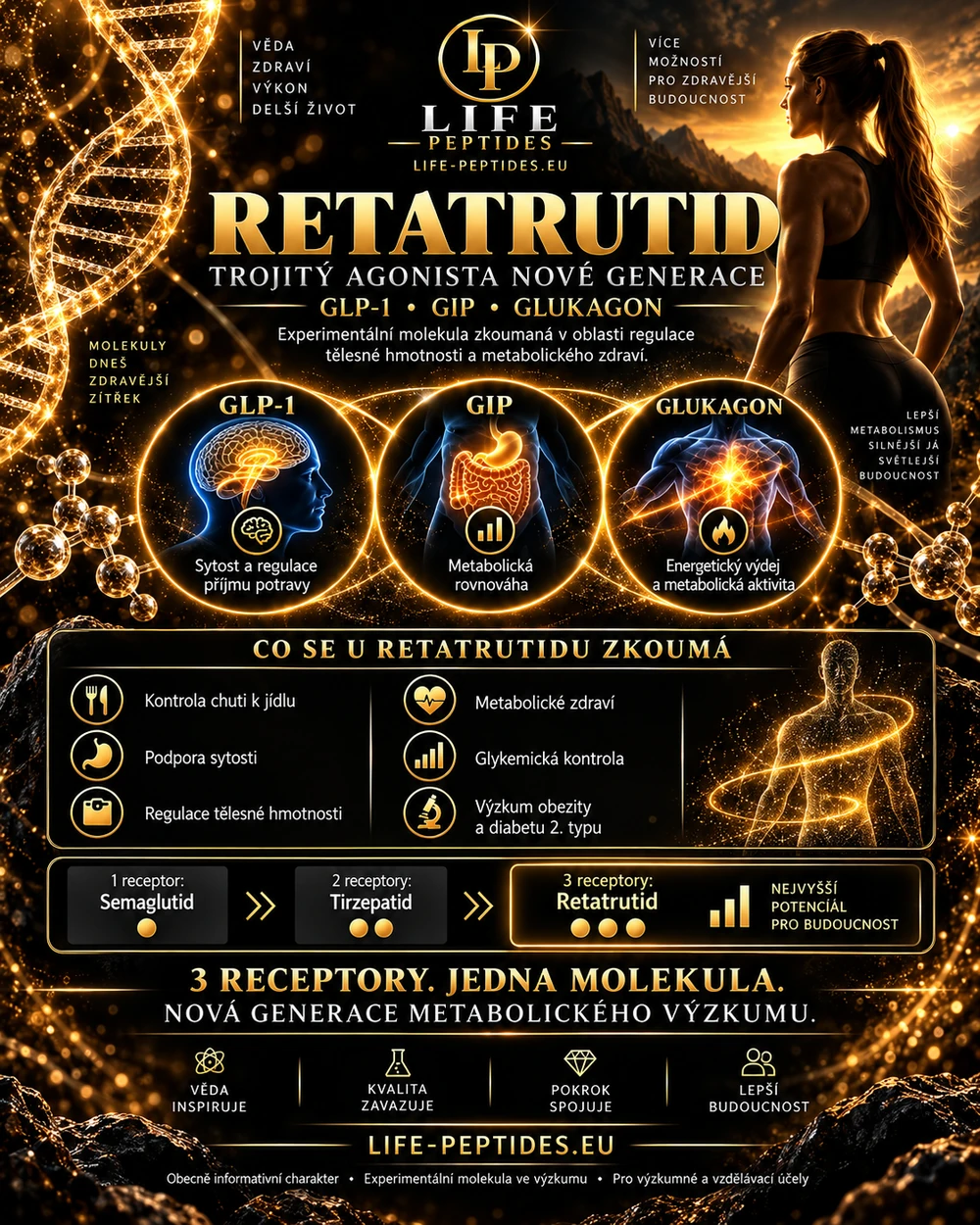
Retatrutide is one of the most closely watched molecules in current obesity and metabolic-disease research. Unlike compounds focused on one or two hormone receptors, it activates GIP, GLP-1 and glucagon receptors in a single molecule. The year 2026 brought the first large Phase 3 readouts and substantially expanded the available clinical evidence.
It is essential to distinguish clinical research from approved treatment. Retatrutide remains an investigational molecule in clinical development and is not an approved medicine for routine clinical treatment. In July 2026, Eli Lilly said it planned a U.S. regulatory submission in the first quarter of 2027.
What is retatrutide and what makes it different?
Retatrutide, also known by the development code LY3437943, is a peptide designed to act as an agonist at three hormone receptors: GIPR, GLP-1R and the glucagon receptor (GCGR). A Phase 2 trial published in the New England Journal of Medicine in 2023 had already shown that this triple-receptor approach could produce substantial changes in body weight.
The informal label “GLP-3,” sometimes used on social media, is not a scientific name. There is no GLP-3 hormone; the more accurate description is a GIP/GLP-1/glucagon triple receptor agonist.
TRIUMPH-1: the first large Phase 3 obesity data
TRIUMPH-1 enrolled adults with obesity or overweight and at least one weight-related complication, without type 2 diabetes. According to topline results released in May 2026, participants in the highest studied dose group had an average body-weight change of −28.3% at 80 weeks. 45.3% of participants achieved at least 30% weight loss.
In a prespecified extension among participants with a baseline BMI of at least 35, follow-up continued to week 104. In that extension, the highest-dose group reached an average weight change of up to −30.3%. These are clinical-trial averages and should not be interpreted as predictions for any individual.
Key Phase 3 results at a glance
The overview below summarizes the most notable publicly released results from the individual trials. These values reflect specific study arms and should not be interpreted as an expected result for an individual.
| Trial | Study population | Duration | Reported weight change |
|---|---|---|---|
| TRIUMPH-1 | Obesity / overweight, without type 2 diabetes | 80 weeks | up to −28.3% |
| TRIUMPH-2 | Obesity / overweight + type 2 diabetes | 80 weeks | up to −20.8% |
| TRIUMPH-3 | Severe obesity + cardiovascular disease | 80 weeks | up to −22.6% |
| TRANSCEND-T2D-1 | Type 2 diabetes | 40 weeks | up to −16.8% |
Other major 2026 results
TRIUMPH-2
In July 2026, Lilly announced positive topline results from TRIUMPH-2 in adults with obesity or overweight and type 2 diabetes. The largest reported average weight reduction was 20.8% at 80 weeks.
TRIUMPH-3
In TRIUMPH-3, which included adults with severe obesity and established cardiovascular disease, the largest reported average weight reduction was 22.6% at 80 weeks.
TRANSCEND-T2D-1
The first Phase 3 trial focused on type 2 diabetes, TRANSCEND-T2D-1, also produced important 2026 data. Results presented at the American Diabetes Association's 86th Scientific Sessions showed weight reduction of up to 16.8% over 40 weeks and an HbA1c reduction of approximately two percentage points in the highest-performing groups.
Safety and tolerability
Large weight changes do not mean an absence of adverse effects. In TRIUMPH-1, gastrointestinal events were the most commonly reported. Across the retatrutide dose groups, nausea occurred in approximately 28.6–42.4% of participants, diarrhea in 25.2–34.1%, constipation in 23.8–26.1% and vomiting in 10.6–25.3%. Discontinuation due to adverse events ranged from approximately 4.1–11.3% in the active groups.
The safety profile will continue to be refined through longer follow-up, additional trials and subsequent regulatory review.
Has retatrutide already been proven superior to tirzepatide?
Not yet. Comparing percentages across separate clinical trials can be misleading because participant populations, study duration, design and statistical methods differ.
That is why the Phase 3 TRIUMPH-5 trial is directly comparing retatrutide with tirzepatide in adults with obesity. ClinicalTrials.gov currently lists an estimated study completion in December 2026. Head-to-head data will provide a more meaningful direct comparison.
Research beyond body weight
The retatrutide development program also examines metabolic, cardiovascular and kidney outcomes and obesity-related complications. The large TRIUMPH-Outcomes trial, for example, is evaluating whether retatrutide can reduce serious cardiovascular events or worsening kidney function in a high-risk population.
What comes next?
Following positive results from multiple Phase 3 trials, Lilly said it is completing the regulatory data package and plans a U.S. submission for retatrutide in the first quarter of 2027. A submission does not mean automatic approval; regulators will still evaluate efficacy, safety and manufacturing information.
As of September 2026, retatrutide is one of the most notable directions in metabolic research, but it remains investigational. Clinical-trial results should not be interpreted as individual treatment advice.
Summary
- Retatrutide activates GIP, GLP-1 and glucagon receptors.
- TRIUMPH-1 reported an average weight change of −28.3% at 80 weeks in the highest studied group.
- Positive 2026 data were also reported from TRIUMPH-2, TRIUMPH-3 and TRANSCEND-T2D-1.
- The TRIUMPH-5 trial is directly comparing retatrutide with tirzepatide.
- Retatrutide remains investigational; Lilly has indicated a planned U.S. submission in Q1 2027.
Information current to September 10, 2026. This article is for educational and informational purposes. It is not medical advice, a guide to use, or a treatment recommendation.


